Security Guard Services: A Complete Planning Guide for Properties and Workplaces
Published 25 September 2026·15 min read
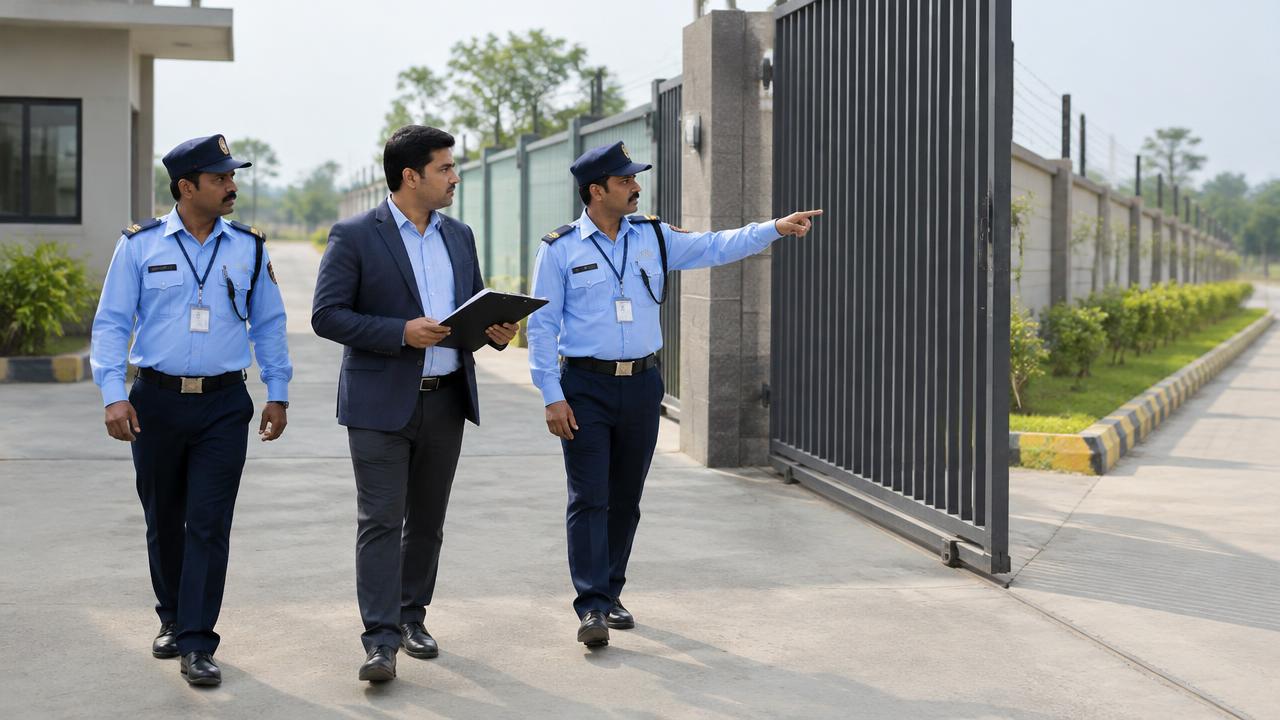
Illustrative image; not a photograph of a confirmed deployment.
Why structured security planning matters
Hiring guards is only one part of protecting a property. A person standing at a gate without a clear brief, patrol plan, reporting process or escalation route cannot deliver consistent protection. Effective security guard services begin with decisions about what needs protection, where vulnerabilities exist, how people and vehicles should move, and what staff should do when normal activity changes. This is why two sites with the same number of guards can achieve very different results. One may have written post orders, disciplined handovers and active supervision, while the other relies on assumptions and informal instructions. The difference is the operating system around the people, not simply the headcount.
Residential societies, offices, factories, warehouses, schools, hospitals and hotels in Lucknow all have different movement patterns. A society manages residents, domestic workers, deliveries and visitors. A factory manages employees, contractors, materials and restricted production areas. A school has intense arrival and departure periods, while a hospital receives anxious visitors throughout the day and night. Planning must reflect these realities. This guide provides a practical framework for assessing risk, defining posts, managing access, organising patrols, improving reporting and reviewing performance. It is operational guidance rather than legal advice, and site owners should confirm current regulatory, fire-safety and local-authority requirements with qualified professionals.
Begin with a realistic site assessment
Walk the entire property before deciding deployment. Record every entrance, exit, service gate, basement ramp, staircase, terrace door, boundary wall and adjoining access point. Include routes that are rarely used, because neglected secondary entrances often create larger gaps than a busy main gate. Note lighting quality after dark, camera coverage, broken locks, overgrown areas, concealed corners and places where parked vehicles or stored material obstruct visibility. Repeat part of the walk during the hours when the site is quiet. A location that appears controlled at midday may be exposed during an early-morning shift change or after nearby businesses close.
Then map normal activity. Identify employee timings, resident and visitor peaks, school transport periods, delivery windows, contractor movement, housekeeping shifts and material dispatches. Review previous incidents and recurring complaints without assuming that the last incident is the only risk. The purpose is not to imagine every possible threat; it is to distinguish routine activity from exceptions that deserve attention. Rank vulnerabilities by likely impact and practical ease of control. Better lighting, a repaired gate or a revised delivery route may remove a risk more reliably than adding another static guard. The completed assessment should explain why every proposed post, patrol and procedure exists.
Translate risk into posts and coverage
A post plan defines where personnel are deployed and the purpose of each position. Typical posts include the main entrance, service gate, reception, parking entry, loading bay and a mobile patrol. Avoid creating posts only because somebody has always stood there. Each location should address an identified need: verifying visitors, controlling vehicles, protecting material movement, monitoring a restricted area or providing rapid response. Where budgets are limited, a planned patrol covering several lower-risk points may be more useful than spreading staff so thinly that no position receives meaningful attention.
For each post, write a short post order covering active hours, core duties, records to maintain, equipment issued, handover requirements and escalation contacts. State what normal activity looks like and list examples that should be reported. Include relief arrangements for breaks so that critical gates do not remain unattended. Coverage should also account for weekly leave, absence and training; a plan that works only when every scheduled person is present is not resilient. Review whether technology, barriers or layout changes can support personnel without creating a false belief that a camera or access card replaces observation and judgement.
Define duties that can be observed and checked
Instructions such as “remain alert” or “guard the gate” are too vague to supervise. Convert them into actions: verify visitors before entry, confirm the host, record vehicle numbers, check passes for outgoing material, inspect designated doors at closing time, complete patrol checkpoints and report defects before shift end. Clear duties help guards understand priorities when several things happen at once. They also allow supervisors and clients to review performance fairly, because compliance can be checked through records, observation and discussion rather than personal impressions.
Boundaries are equally important. Security personnel should not be expected to repair electrical equipment, settle private disputes, perform hazardous interventions or make unsupported legal decisions. The post order should explain when to observe, when to deny access according to policy, when to call a supervisor and when emergency services must be contacted. Courtesy standards should be explicit: visitors can be screened firmly without being humiliated, and residents or employees should follow the same published rules rather than pressuring guards for informal exceptions. Consistency protects both the site and the person on duty.
Build disciplined access control
Access control starts by grouping people according to their relationship with the site. Employees or residents may use an identity card, sticker or approved list. Regular domestic staff and vendors may require registration and time restrictions. Unknown visitors should provide basic details, state their purpose and receive confirmation from the person they are visiting. Contractors may need an escort or temporary badge. Define these categories in advance so guards do not invent rules at the gate or depend on personal familiarity. Any collection or storage of identity information should follow applicable privacy and legal requirements.
Visitor records should normally capture name, contact information, host, purpose, arrival and departure time. Vehicle records help identify overstays and support parking control. Sensitive workplaces may restrict photography, devices or access to server rooms, stores and production areas. Residential properties should decide how deliveries, taxis and ride services are handled when residents cannot be reached. A clear exception process is essential: the guard should know who has authority to approve entry and how that approval is recorded. Regular review prevents old vendor lists, expired passes and former employee details from remaining active indefinitely.
Manage vendors, contractors and materials
Contractors frequently need access to less visible areas such as rooftops, utility rooms, service corridors and vacant units. Ask the requesting department or resident to provide advance notice, expected work hours and the areas required. At arrival, verify identity and work purpose, issue a temporary pass where appropriate, and record tools or equipment brought inside. Longer work may require an authorised escort or periodic checks. Badges, keys and access cards must be returned when work finishes; familiar vendors should not retain unrestricted access simply because they have served the property for years.
Material movement needs a separate control. Incoming deliveries should be matched with the receiving person or department. Outgoing goods, scrap, equipment or stock should have an authorised gate pass that identifies the item, quantity, vehicle and approver. Guards should record discrepancies rather than resolving commercial questions themselves. Loading areas also require traffic control, safe pedestrian separation and clear stopping zones. These steps reduce theft risk and disputes while creating an audit trail. They should be proportionate to the site: a small society needs a simpler process than a warehouse, but both need clarity about who may remove property.
Design purposeful patrols and night coverage
Patrol routes should cover places that static posts cannot see: rear boundaries, basements, stairwells, terraces, utility zones, vacant floors and storage yards. Specify checkpoints and what must be inspected at each one, such as locks, lights, fire exits, water leakage, unusual odours, unattended objects or signs of forced entry. Timing should vary enough to avoid a predictable pattern while still meeting an agreed frequency. A paper register, radio check-in or electronic tour system can confirm completion, but the value lies in meaningful observation rather than collecting signatures.
Night coverage needs additional safeguards because reduced activity, fatigue and limited supervision can weaken performance. Provide suitable lighting, working communication equipment and defined welfare breaks. Avoid leaving one person isolated in a high-risk area without a check-in process. Supervisors should occasionally visit during night hours, not only on daytime rounds. Seasonal conditions matter too: monsoon waterlogging may change patrol routes, winter fog can reduce visibility and festival activity can increase late movement. Update patrol instructions when site conditions change rather than treating the original map as permanent.
Make every handover count
Shift change is a predictable point of vulnerability. The outgoing guard may know that a contractor remains inside, a camera is not working, a resident reported suspicious movement or a key has not been returned. If this information is passed casually, the incoming person begins with an incomplete picture. Use a written handover log supported by a brief face-to-face exchange. Record pending visitors, incidents, equipment condition, open gates, expected deliveries, temporary instructions and any follow-up required. Both personnel should acknowledge the handover.
Schedules should balance continuity and fatigue. Longer shifts reduce the number of handovers but can reduce attention, especially overnight; shorter shifts require more coordination. Choose the arrangement that can be staffed reliably and complies with applicable requirements, rather than selecting hours only to reduce cost. Rotate posts enough to prevent complacency while retaining sufficient familiarity for guards to recognise normal occupants and activity. Relief staff must receive the same site briefing as regular personnel. A substitute who knows only the address, but not the post order, is not adequate continuity.
Use incident reports as management tools
Every incident report should answer five questions: what happened, when and where it happened, who was involved, what immediate action was taken, and who was informed. Keep language factual and avoid assumptions about motive. Record minor events as well as serious ones, because repeated small observations can reveal a pattern: a door that is often found open, one vendor repeatedly leaving late or lights failing in the same area. Reports should reach the responsible manager promptly instead of remaining unread in a gate register.
Daily occurrence books, visitor registers, patrol logs, key records and material passes form a connected record. Supervisors should sample them for completeness, unusual corrections and missing exit times. Digital systems can improve searchability, but a poorly followed app is no better than a poorly maintained register. Decide how long records are retained, who may see them and how personal information is protected. After an incident, review the process rather than focusing only on individual blame: determine whether the post order was clear, staffing was adequate, equipment worked and escalation occurred on time.
Prepare for emergencies before they occur
Security personnel are often first to notice a fire alarm, medical emergency, disturbance or attempted intrusion. Their role should be defined before pressure arrives. Display current contact details for site management and emergency services. Mark assembly points, exits, isolation controls and access routes for emergency vehicles. Clarify who raises an alarm, guides people, opens gates, meets responders, protects the scene and records events. Site-specific briefing matters because generic knowledge does not tell a new guard where the nearest extinguisher or emergency gate is located.
Run periodic drills with the property team, not security in isolation. A drill may reveal a blocked route, a missing key, poor radio coverage or confusion over who contacts management. Record lessons and assign corrective actions. Guards should receive basic role-appropriate instruction, but they should not be asked to perform specialised medical, fire or law-enforcement tasks beyond their competence. For legal and regulatory obligations, obtain current guidance from the relevant authority or qualified adviser. Practical readiness is built through simple, repeated actions rather than a thick emergency manual nobody has practised.
Supervision, training and technology
Supervision connects written plans to actual conduct. Agree how often field supervisors will visit, including occasional unannounced and night checks. Reviews should cover attendance, grooming, alertness, registers, post knowledge, equipment and recent incidents. The client should also nominate one responsible contact who reviews summaries and resolves recurring operational questions. This is oversight, not daily interference: guards work best when instructions flow through a clear chain rather than from several residents, employees or department heads giving conflicting directions.
Training should include site induction, access rules, visitor handling, communication, fire awareness, incident reporting and respectful conduct. Refresher briefings are needed when procedures change or records show repeated mistakes. Technology can extend coverage through cameras, intercoms, alarms, barriers and digital visitor systems, but every device needs an owner, maintenance schedule and fallback process. A broken camera that everyone assumes is recording creates more risk than an openly recognised blind spot. Decide who monitors alerts, who checks equipment and what guards should do during power or network failure.
Review performance and choose responsibly
Review the arrangement monthly at first and at suitable intervals once stable. Check attendance and punctuality, completed patrols, visitor and material records, incident response, complaint patterns, supervisor visits and unresolved site defects. Ask occupants whether rules are applied consistently and whether guard communication is professional. Update the risk assessment after layout changes, new tenants, construction, changed operating hours or a significant incident. Security is not a fixed purchase; it is a managed service that should evolve with the property.
When comparing agencies, look beyond the lowest monthly figure. Ask how personnel are selected and verified, how site induction works, how absence and replacement are handled, what supervision is included, which equipment is supplied, and how complaints are escalated. Put duties, hours, commercial terms and responsibilities in writing. Do not accept unsupported claims about outcomes, credentials or affiliations; request documents relevant to your requirement and verify current obligations independently. For a site-based review and an approved quotation aligned with these planning principles, Swaraj Security Guard Services can discuss your property’s actual coverage needs without substituting generic promises for assessment.