Human Security Guards vs CCTV and Smart Security Systems: Why the Right Combination Matters
Published 17 October 2026·15 min read
Buyer guide 9 of 10 · Editorial series date: 7 October 2026. Published on the date above.
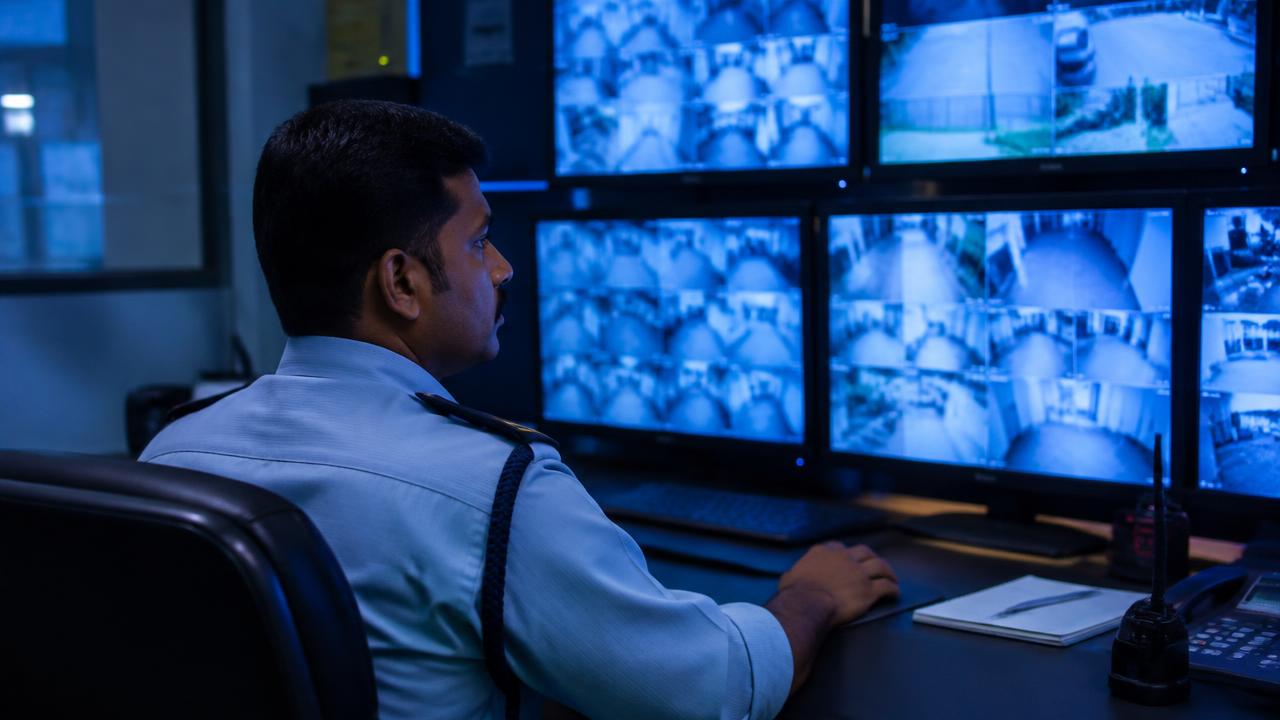
Illustrative image; not a photograph of a confirmed deployment.
The direct answer: combine detection, judgement and response
Security guards and CCTV surveillance work most effectively together when each has a defined job. Cameras extend visibility and preserve useful records; guards interpret situations, manage entry and take appropriate action. Access control helps enforce permissions, while an incident response plan tells people what to do when something goes wrong. None of these elements alone provides complete protection. A camera cannot assist a confused visitor, and a guard cannot continuously observe every staircase, gate and loading bay.
For a business owner or residential property manager, the practical starting point is not choosing people over technology. It is identifying what must be protected, where unauthorised access or unsafe conditions could arise, and how quickly a responsible person must respond. Then match each risk with detection, verification and response arrangements. A small office may need a controlled reception and targeted camera coverage; a large housing society may need separate visitor, delivery and vehicle procedures. Build the arrangement around actual operating conditions, not the number of devices or uniforms offered in a proposal.
Map the property before specifying equipment or posts
Walk the property during opening, peak activity and closing hours. Mark pedestrian entrances, vehicle gates, emergency exits, service routes, parking ramps, delivery points and places where visibility changes after dark. Record who uses each area and why. A loading bay presents different concerns from a residential lobby: goods reconciliation and contractor access matter at one, while visitor verification and resident convenience dominate at the other. Include accessible routes so that security controls do not create unnecessary barriers for elderly people or persons with disabilities.
Turn this walkthrough into a simple risk-and-task map. For each location, state the concern, existing control, remaining weakness and person responsible for acting. For example, a rear entrance may have a camera but no door-status alert, leaving prolonged opening unnoticed until footage is reviewed. Consider power failures, internet disruption, rain, poor lighting and staff absence. Ask occupants and operational teams about recurring difficulties without treating anecdotes as verified crime patterns. This exercise helps distinguish a genuine coverage gap from a problem that clearer permissions, better lighting or a revised delivery schedule could solve.
What physical guards contribute, and where they need support
A guard can engage with people, notice context and adapt a response. Someone repeatedly trying the wrong door may be lost, distressed or attempting unauthorised entry; a respectful conversation can clarify the situation. Guards can verify appointments through authorised contacts, guide queues, observe handovers, report hazards and summon help. Their presence also makes security procedures visible, which can discourage casual rule-breaking. These benefits depend on suitable deployment, site induction, supervision and clear instructions rather than the job title alone.
Human coverage has limits. Fatigue, interruptions, poor sightlines and simultaneous demands can cause missed events. A guard handling a vehicle dispute cannot also inspect every pedestrian entry or continuously watch multiple camera feeds. Avoid assigning reception, parcel handling, patrol and active monitoring to one person without testing workload. Provide an escalation route when a situation exceeds authority or competence. Private guards do not have general police powers: screening should be lawful, proportionate, respectful and based on consent or an applicable entry policy. Instructions should emphasise de-escalation, observation and contacting appropriate authorities, not coercive searches or confrontation.
What CCTV can establish, and what it cannot prevent
CCTV is useful for observing selected areas, checking an alert and reconstructing events. Its value depends on the intended task. A wide view may show congestion but fail to provide usable identification; a camera aimed at a doorway may miss activity behind a parked vehicle. Define whether each view is intended to detect presence, understand movement or support identification, and have a competent technical provider assess the design. Check actual recordings in daytime, darkness and difficult lighting rather than accepting a live demonstration as proof of reliable evidence.
Recording does not equal active surveillance. If nobody reviews feeds or receives relevant alerts, footage may help only after an event. Even monitored cameras can miss incidents because of blind spots, obstruction, glare, network failure or operator overload. Establish who checks camera health, how faults are reported and how recording availability is verified. Technical installation, configuration and repair should be separately assigned to an appropriately qualified provider; they should not be assumed to form part of guarding. Guards can report a blank display or displaced camera without opening equipment, repairing wiring or attempting unsafe access.
Use access control to manage permission, not merely entry
Access control works when the organisation knows who may enter, where they may go and when permission ends. Cards, mobile credentials, intercoms and visitor registers support that policy; they do not create it. Define approval authority for employees, residents, contractors, domestic workers, delivery personnel and temporary visitors. Include joiner and leaver procedures, lost credentials, vendor work windows and changes in occupancy. Guards should verify exceptions through an approved channel instead of relying on familiarity or accepting an urgent verbal claim from an unknown person.
Watch for tailgating, shared credentials, doors held open for convenience and access permissions that remain active after a contract ends. Use camera views and guard positioning to support access checks without creating excessive queues. Provide a workable manual procedure during system failure, with limited temporary permissions and later reconciliation. Emergency egress must remain safe and consistent with applicable requirements; a security lockdown must not trap occupants. For visitor identification, collect only information justified by the policy and applicable law. Avoid routine copying of complete identity documents when a less intrusive verification method would meet the need.
Treat smart alerts as leads that require verification
Motion alerts, line-crossing rules, door-held-open signals and other analytics can help direct attention. Their usefulness depends on configuration and the environment. Shadows, animals, moving vegetation, crowds or vehicle headlights may generate nuisance alerts, while occlusion can hide relevant activity. Start with a small number of meaningful rules linked to specific risks. A night-time alert at a closed service entrance may deserve immediate verification; constant movement notifications from a busy reception are unlikely to help anyone prioritise.
For each alert, specify who receives it, how they verify it, whom they contact and how they close the record. Test notification delivery during weak connectivity and when the usual recipient is unavailable. Review false alerts alongside missed events rather than judging success by alert volume. Avoid assuming facial recognition or other biometric processing is necessary: consider less intrusive alternatives and obtain qualified privacy and legal advice before adoption. Smart systems should support accountable human decisions, not automatically label a person as an offender. If an alert prompts an approach, the guard should use neutral language and follow the site's lawful procedures.
Build a response chain that remains safe under pressure
An integrated arrangement needs a sequence: detect, verify, classify, notify, respond safely and record. Distinguish routine exceptions from urgent threats. An unverified visitor may require a call to the host; smoke, violence or an immediate threat to life requires urgent escalation through appropriate emergency channels. Give guards clear contact routes, site location details and instructions for guiding responders. Identify who can authorise operational decisions such as suspending deliveries, closing a non-emergency access point or informing occupants.
Define boundaries as carefully as duties. Guards should not undertake electrical repairs, hazardous intervention, medical treatment or specialised firefighting beyond their competence. Where safe and consistent with training and instructions, they may raise an alarm, keep others away from danger, support evacuation and direct emergency responders. Do not make a lone guard leave a critical entrance unattended to investigate a potentially dangerous alert. Agree alternative coverage or remote verification first. Test the escalation chain when a manager does not answer, and name a backup role rather than relying on one individual's availability. Response expectations should reflect the actual layout, staffing and risk.
An explicitly hypothetical worked operational scenario
Hypothetical example: a residential complex has a staffed main gate, a separate service entrance, an access-controlled service door and CCTV covering the approach. At 10.40 pm, the door-held-open system sends an alert. The main-gate guard checks the relevant camera view and sees a delivery worker holding the door while another person approaches. The guard does not assume a crime or abandon the main gate. Using the approved communication channel, the guard asks the designated patrol colleague to observe from a safe position and contacts the resident or supervisor authorised to verify the delivery.
The authorised contact confirms one delivery worker, but not the second person. The patrol colleague respectfully directs the unverified person to the normal visitor process without searching or detaining them. If the person becomes threatening, staff withdraw to safety and escalate as appropriate. After access is resolved, the door is checked for normal closure without attempting technical repairs. The event record captures the alert, verification, contacts, actions and relevant footage reference. Management then checks whether the delivery procedure caused avoidable door-holding. The lesson is coordinated coverage and proportionate action, not automatic reliance on an alert.
Assign responsibilities and protect surveillance information
The property manager or business owner should approve the security policy, access rules, privacy arrangements and operational priorities. The guarding supervisor should translate these into post instructions and verify understanding. A designated technical provider should own equipment configuration, maintenance and fault resolution within the agreed scope. Occupants, employees and tenants also have responsibilities: keeping credentials secure, approving visitors through the agreed route and reporting lost access devices. Document boundaries between security, housekeeping, hospitality and facility teams so that unrelated requests do not quietly displace essential coverage.
Assign named roles for viewing footage, exporting clips, approving disclosure and deleting records under the retention policy. Restrict access, avoid shared administrator credentials and maintain an export trail. Do not circulate incident clips casually in resident or staff messaging groups. Position cameras to serve legitimate security purposes without intruding into private spaces, and use appropriate notices. Set retention according to documented need and applicable requirements rather than keeping everything indefinitely. Obtain qualified advice on applicable Indian data protection and other legal obligations, including implementation timelines relevant to the site. Preserve specific records appropriately when an incident or lawful request requires it.
Build a realistic monthly cost and post-hour model
Compare total operating cost, not only a guard rate or camera purchase price. An algebraic framework is M = G + T + O + V, where M is monthly cost before applicable taxes, G is guarding, relief and supervision, T is technology rental or monthly capital allocation, O is connectivity, power backup, storage and maintenance, and V is variable or separately authorised work. Avoid counting the same item twice when a vendor bundles services. Show applicable taxes separately after professional verification. Statutory wages, effective dates, sources, contribution rules, overtime treatment and GST must be checked for the actual location, engagement and scope by qualified advisers.
Hypothetical post-hour calculation: one continuously covered entrance position for a 30-day month requires 24 × 30 = 720 coverage hours. A separate peak-period position operating four hours on each of 26 days adds 104 hours, giving 824 post-hours. This is coverage demand, not a legal staffing calculation or permission for excessive shifts. The roster must separately account for lawful working hours, weekly rest, leave, breaks, training and replacement arrangements. Compare proposals against identical coverage assumptions and ask how exclusions, relief, equipment ownership and maintenance responsibilities affect the monthly total.
Implement in stages with an actionable acceptance checklist
Begin with the risk map, then agree the operating concept before purchasing or changing deployment. Write post duties, camera purposes, access permissions and escalation routes together so they support one another. Pilot the arrangement at a selected entrance or during one defined operating period. Brief guards, reception staff, occupants and relevant contractors on what changes and why. Keep a controlled fallback process available while credentials, alerts and visitor approvals are being tested. Do not remove existing coverage simply because new equipment has been delivered.
Use this acceptance checklist as a sequence of practical checks: confirm every entrance has an owner; walk camera views in daylight and darkness; verify recording and timestamps; test authorised and refused access; check visitor queues; simulate a missing credential; test power and connectivity fallback safely with the technical provider; confirm emergency exits remain usable; check primary and backup contacts; practise an alert without abandoning a critical post; and verify incident records can be retrieved only by authorised people. Record each result, unresolved issue, responsible person and completion target. Management should accept the arrangement after correcting material gaps, not merely after receiving an installation invoice.
Use one reusable briefing and incident record
Create a combined briefing format that begins with the site, date, shift, post and names or role identifiers of the outgoing and incoming staff. Next record expected visitors or contractor work, temporarily restricted areas, unavailable cameras or access devices, outstanding incidents and the current escalation contacts. Include the authorised fallback for each equipment fault. Close the briefing with an acknowledgement that keys, communication devices and pending tasks have been handed over. Keep sensitive personal information out unless operationally necessary, and store the record with controlled access.
For an incident entry, use the same predictable sequence: occurrence time, reporting time, exact location, source of detection, direct observations, verification attempted, people contacted, instructions received, actions taken, outcome and follow-up owner. Separate facts from assumptions and use neutral descriptions. Add the camera identifier and relevant time range rather than copying footage into an uncontrolled file. Record whether a clock discrepancy could affect retrieval. A supervisor should check that unresolved events appear in the next briefing. This format makes handovers useful, supports later review and reduces the risk that an unresolved door fault or repeated access exception disappears between shifts.
Correct common mistakes and measure useful outcomes
Common mistakes include buying more cameras without identifying blind spots, displaying too many feeds for one operator, placing the monitor where gate duties constantly interrupt viewing, and assuming a barrier prevents pedestrian entry. Another is leaving all system passwords with the installer while management has no controlled recovery process. On the human side, vague instructions such as 'check everyone strictly' invite inconsistent treatment. Replace them with specific approval routes, respectful screening rules and clear escalation criteria. Avoid judging guards solely by the number of people stopped; that can reward unnecessary friction.
Review practical indicators: equipment fault duration, unresolved access exceptions, alert acknowledgement, incident record completeness, queue delays and recurring door-held-open events. Interpret results in context; a low incident count does not prove that detection is working. Sample recordings and logs through authorised review, and test procedures with safe exercises rather than surprise confrontations. Investigate repeated nuisance alerts or failed visitor approvals as system problems, not automatically as individual misconduct. Hold a periodic joint review with the operational owner, guarding supervisor and technical provider. Assign corrective actions with ownership and verify that changes improve both security and everyday usability.
FAQs: Can cameras replace guards, and must feeds be watched continuously?
Can CCTV replace a guard at a small property? Sometimes technology can reduce a particular manual task, but replacement should follow a risk and workload assessment. Remote verification may suit a low-traffic entrance with reliable access control and a clear response arrangement. It is less suitable where visitors need assistance, deliveries require checking, disputes are frequent or people need immediate guidance. Ask who will act when the camera shows a problem, how access will work during failure and whether removing the post leaves other duties uncovered. Cameras do not remove the need for accountable response.
Must someone watch every camera continuously? Not necessarily. Choose between recorded coverage, event-based monitoring and continuous observation according to the risk at each location. Continuous monitoring may be justified for selected critical views, but operator workload and relief still matter. Event-based monitoring can reduce screen-watching if alerts are reliable and reach someone able to respond. Recorded-only coverage should be described honestly as retrospective support, not live protection. Document the mode for each camera group and test it against realistic conditions. The important question is whether relevant events become actionable in time, not whether a wall of screens is switched on.
FAQs: How should failures and footage requests be handled?
What should happen when power, internet or access control fails? Use a pre-agreed degraded-operation plan. Identify which systems retain local operation, which need connectivity and which stop working. The technical provider should assess backup capacity and safe testing; guards should report failures and follow approved manual entry procedures. Temporary logs, controlled visitor approvals and revised patrol priorities may be appropriate, but do not leave critical posts uncovered or compromise emergency exits. Record temporary permissions and reconcile them after restoration. If safe operation cannot be maintained, the authorised manager should decide what activities must be restricted.
Can residents, employees or visitors demand a copy of footage? Do not treat every request as an automatic right to unrestricted copies, nor dismiss it without review. Direct requests to the designated authorised person, who should assess applicable rights, lawful purpose, third-party privacy and any police or legal process. Preserve relevant material when appropriate while the request is considered. Record the request, decision, authorisation and disclosure method. Guards should not export clips informally to settle disagreements. An approved process protects both the requester and other people captured, while maintaining the integrity of records that may later be needed for an investigation.
Conclusion: buy a working operating arrangement
The right combination of guards, CCTV, access control and response procedures is the one that closes identifiable gaps without creating unsafe or impractical duties. Start by listing the three situations that would most disrupt your property: perhaps unauthorised entry, an unattended service door and congestion at a delivery gate. For each, write down how it will be detected, who will verify it, who may authorise action and what happens if the normal system fails. Any blank answer is a design issue to resolve before expanding the equipment list.
When comparing providers, request a scope that distinguishes manpower, supervision, monitoring, technical work and management responsibilities. Verify applicable credentials and legal requirements rather than assuming them from a proposal's wording. Require a workable roster, clear privacy controls, a common briefing record and an acceptance test matched to your site. Set a review point after implementation to examine faults, workload and user feedback. Good integration does not mean maximum technology or maximum staffing. It means that people, permissions and information connect reliably enough for an appropriate, lawful and safe response when attention is needed.