Security Guard Services for Residential Societies: A Complete Guide for RWA and Apartment Associations
Published 17 October 2026·15 min read
Buyer guide 2 of 10 · Editorial series date: 2 September 2026. Published on the date above.
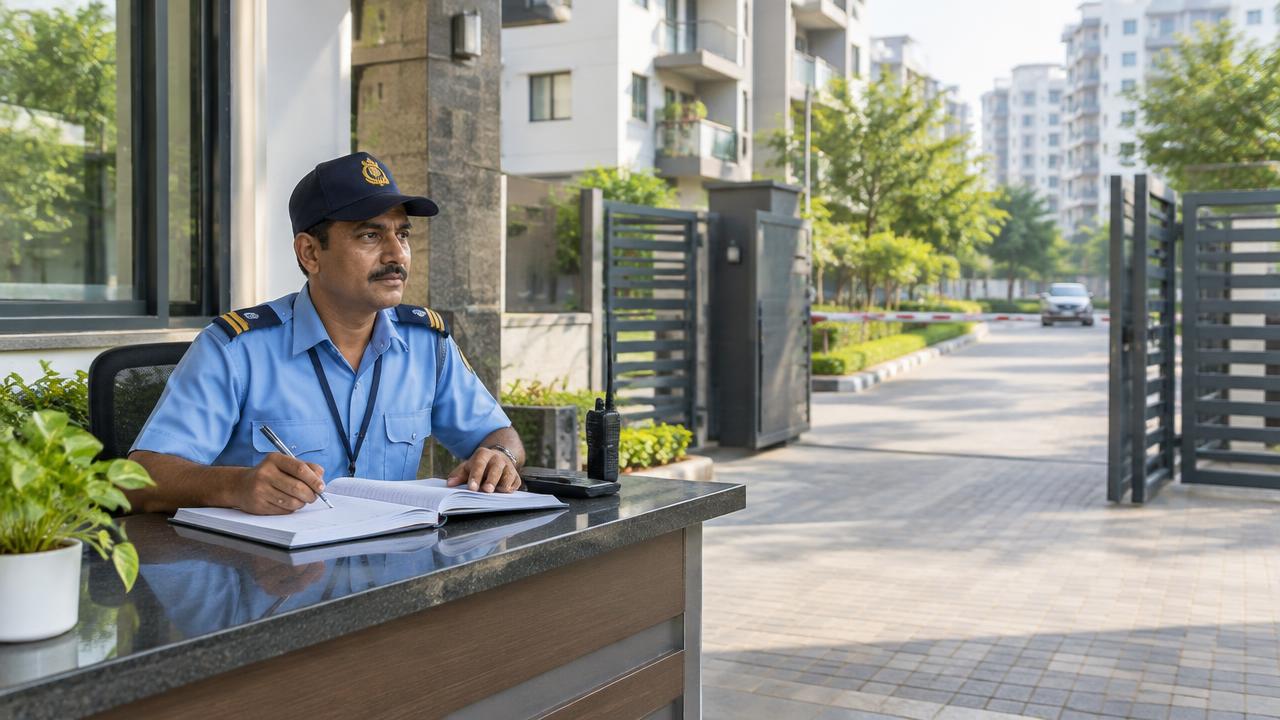
Illustrative image; not a photograph of a confirmed deployment.
What residential society security should deliver
Security guards for residential societies should provide controlled access, orderly movement, regular observation and a reliable response when something goes wrong. For an RWA or apartment association, the starting point is not simply the number of guards at the gate. It is a written operating plan explaining which entrances remain open, how visitors receive approval, where deliveries go, what patrols cover and whom guards contact when they need help. The plan must work during busy mornings, late arrivals, staff breaks and equipment outages.
A practical arrangement combines trained personnel, usable infrastructure, resident cooperation and active supervision. Guards cannot compensate indefinitely for broken gates, unreadable flat directories, poor lighting or conflicting committee instructions. Before appointing a provider, walk through the property and convert everyday problems into clear duties. This guide explains how to define those duties, assess staffing and costs, maintain useful records and review performance. Its recommendations can inform discussions with SWARAJ SECURITY GUARD SERVICES or another provider; they are not claims about any provider’s existing practices or contractual inclusions.
Assess the property and assign responsibilities
Map pedestrian gates, vehicle entrances, basement ramps, service access, boundary gaps and routes to each tower. Record when school transport, domestic workers, office commuters and delivery riders arrive. Check whether a guard at the main entrance can actually see the pedestrian side gate. Identify locations needing extra attention, such as isolated staircases, poorly lit parking corners and shared access with adjoining commercial premises. Separate security concerns from maintenance defects so that a faulty door closer becomes a repair task rather than a permanent instruction to watch harder.
Allocate responsibilities before deployment. The association should approve lawful access rules, authorise expenditure, nominate escalation contacts and communicate changes to residents. The facility manager should coordinate equipment defects, contractor schedules and common-area access. The security provider’s agreed responsibilities should cover deployment, relief, training, supervision and reporting. Residents should approve expected visitors and report lost access credentials promptly. Use one authorised channel for operational instructions rather than allowing every committee member to issue conflicting orders. Record who can approve exceptions and who acts when the primary contact is unavailable.
Plan posts, coverage and relief rather than guessing headcount
Define each post by location, hours and tasks. A main gate post handling pedestrian approval may not simultaneously manage a busy vehicle barrier and conduct tower patrols. Distinguish fixed posts from mobile duties, and identify periods when simultaneous coverage is essential. Observe actual queues and movement before deciding whether peak-hour support is needed. An occupied chair does not prove that the assigned workload is manageable; excessive multitasking often produces missed approvals, incomplete records and unsafe vehicle movements.
Ask bidders to explain how their roster covers weekly rest, leave, meal breaks, training and unexpected absence within applicable working-time requirements. Do not convert round-the-clock coverage into an automatic legal headcount assumption. Review the proposed shifts and relief arrangement with qualified advisers where needed. Each handover should identify unattended issues, expected late visitors, equipment faults and any temporary access restriction. Agree what happens if a replacement is delayed, including who escalates and how essential posts remain covered. A lone gate guard should not be sent on a distant patrol without an authorised alternative for the entrance.
Build a respectful, dependable visitor-entry process
Visitor entry should follow a simple sequence: establish the destination and purpose, contact the resident through an approved channel, obtain confirmation and record the minimum information required by society policy. Pre-approved guests can follow a faster process, but guards should still check that the approval matches the person and visit. Define how approval expires and how incorrect flat numbers are handled. When a resident does not respond, provide a safe waiting option and an escalation route rather than leaving the guard to improvise.
Screening must be consent- or policy-based, proportionate, respectful and lawful. Private guards do not have police powers and should not force searches, seize identity documents or compel someone to unlock a phone. Avoid retaining original IDs or routinely collecting full identity-document copies without a justified, lawful need. Explain any applicable inspection policy in advance and provide an authorised escalation path for refusal. Make workable arrangements for elderly visitors, people with disabilities and residents who cannot use an app. Disputed entry should be handled calmly, without public accusations or discriminatory assumptions.
Manage deliveries without turning the gate into a warehouse
Decide whether food, groceries, medicines, documents and bulky goods follow different procedures. A resident-approved doorstep delivery may be appropriate for one category, while another may use an agreed collection point. Explain these rules to residents and delivery personnel through clear signage and routine communication. Create a waiting location that does not obstruct pedestrians, vehicle visibility or emergency access. Guards should verify the destination and approval, not browse package contents or demand unrelated personal information from riders.
Parcel custody needs separate rules. If gate acceptance is permitted, define which items may be accepted, the acknowledgement method, storage limits and resident collection process. Avoid informal acceptance of valuables, cash-on-delivery obligations, perishables or temperature-sensitive medicines without an expressly agreed arrangement. Record who handed over and collected an accepted parcel without exposing other residents’ details. During a delivery surge, maintain the approval process and request designated support rather than waving everyone through. Guards should not leave an essential post to distribute parcels across towers; delivery convenience must not silently displace access control.
Keep vehicles moving safely and preserve emergency access
Separate resident vehicles, visitor parking, taxis, school transport and goods vehicles in the operating plan. Maintain a controlled process for issuing, replacing and cancelling resident vehicle credentials. A sticker or digital tag should support identification, not automatically override visible discrepancies or reported misuse. Give guards a current visitor-parking allocation and a contact for unavailable spaces. Drivers need clear directions before reaching a narrow ramp or turning area, especially where children and pedestrians cross the vehicle route.
Specify low-speed movement rules, pedestrian priority and locations where stopping is prohibited. Keep fire access routes, hydrant approaches and emergency exits unobstructed under the property’s applicable safety requirements. Guards should report repeated violations through the authorised association process, not invent fines or physically confront drivers. Any towing arrangement requires a separately verified lawful policy and authorised personnel. For moving trucks and renovation vehicles, confirm timing, destination and safe loading arrangements. Manual gate operation should follow equipment instructions; guards must not reach into moving barriers, attempt electrical repairs or stand in a vehicle’s path to stop a dispute.
Make night patrols observable, safe and useful
A night patrol should check defined conditions rather than merely produce a timestamp. Relevant observations include doors that should be secured, unusual movement, water leakage, blocked exits, damaged boundary sections, lighting failures and vehicles obstructing access. Build a route that covers vulnerable areas without abandoning essential gate duties. Include a check-in arrangement for isolated locations and a response if a patroller misses contact. Any variation in patrol timing should remain within an approved plan and preserve required coverage.
Equip patrollers for the environment with functioning communication devices, suitable lighting and weather-appropriate clothing. A supervisor should check whether basement reception and radio coverage are adequate. Guards should observe and report hazards, not enter electrical rooms to diagnose faults, investigate gas smells alone or pursue someone into an unsafe area. Avoid unnecessary noise near homes, and keep patrol conduct respectful of residents’ privacy. Review patrol records for meaningful findings and follow-up, not just identical entries. Technology can support verification, but missed scans may indicate equipment or connectivity problems rather than automatically proving misconduct.
Use incident reports and handovers that support decisions
Separate routine events from incidents requiring escalation. An incident report should state what was observed, where and when it happened, who reported it, what action was taken and who was informed. Distinguish direct observation from a resident’s account, and avoid assigning blame before facts are checked. Record unresolved risk and the next responsible person. Inform the designated contact promptly for serious events; a completed register at the end of the shift is not an adequate substitute for urgent notification.
A reusable briefing and incident template can be described in one page: date, shift, post, personnel on duty, equipment status, expected activities, open defects and special instructions, followed by incident fields for time, location, factual account, immediate action, escalation recipient and time, evidence reference, follow-up owner and closure status. The outgoing and incoming guards should acknowledge the handover. Use an incident reference rather than circulating sensitive details across multiple groups. Set rules for correcting entries without concealing the original record, and keep factual reporting separate from opinions or disciplinary decisions.
Define emergency actions within guards’ competence
The emergency plan should tell guards how to raise an alarm, contact emergency services, guide responders and support evacuation under the property’s approved procedures. Display verified local emergency contacts and maintain an accessible gate-opening arrangement. Identify who can provide building information and who assists residents requiring evacuation support. Practise communication and route clearance so that an emergency does not begin with a search for keys, contact numbers or the correct tower name.
Guards must not perform medical treatment, electrical repairs, hazardous intervention or specialised firefighting beyond their competence and authorisation. Any basic first aid or extinguisher use should depend on appropriate training, safe conditions and the emergency plan; do not assume such capabilities are included in an ordinary guarding contract. For smoke, suspected gas leakage, violence or a serious injury, prioritise alarm, safe distancing, emergency assistance and keeping access clear. Do not require guards to enter dangerous spaces or physically restrain people as a routine response. After the immediate danger, preserve relevant records and document actions without delaying professional help.
Make supervisor responsibilities measurable
Supervision should be a defined service component, not an undefined promise that someone will occasionally visit. Ask who checks deployment, reviews handovers, resolves attendance gaps and coaches guards on the society’s procedures. Agree a visit and review arrangement appropriate to the site, including how night operations are checked. The supervisor should verify that guards understand visitor exceptions, emergency contacts, delivery rules and reporting thresholds. Attendance alone does not show whether these tasks are being performed correctly.
Require follow-up on recurring problems: entry queues, unanswered approval calls, missing patrol findings, equipment defects and resident complaints. A useful review records the issue, likely cause, corrective action, owner and target completion date. Supervisors should also identify fatigue, unsuitable post conditions and tasks added without staffing review. The facility manager remains responsible for arranging repairs and administrative decisions within their remit; supervisors cannot solve infrastructure defects merely by issuing warnings to guards. Assess supervision through closed actions and improved consistency, while allowing guards to report unsafe or conflicting instructions without pressure to hide operational problems.
Protect resident information and control digital access
Visitor registers, staff attendance details, vehicle records and entry photographs can reveal residents’ routines. Define what information is necessary, why it is collected, who may access it and when it should be deleted, subject to applicable legal requirements. Keep paper registers away from casual viewing and restrict digital accounts by role. Avoid shared passwords and remove access promptly when personnel change. Residents should not receive unrestricted access to other households’ visitor records simply because they belong to the association.
If an app or CCTV system supports operations, establish who administers it, who can retrieve records and how requests are authorised. Camera monitoring, installation, repairs and technical maintenance are separate scopes unless expressly included. Guards should not circulate footage or identity documents through personal messaging groups. Preserve relevant material through an authorised process when an incident requires investigation, and document any lawful disclosure. Verify privacy and retention arrangements with qualified advisers and relevant technology vendors. Provide a paper or approved offline fallback so that a network failure does not lead to uncontrolled entry or excessive data collection.
Compare monthly costs using coverage and verified assumptions
Start with post-hours. Let H equal the sum of each post’s daily coverage hours multiplied by its operating days. A planning framework is M = L(H, R) + C + O + S + E + F + T, where L is ordinary labour cost under the coverage and relief roster R, C is applicable employer statutory costs, O is lawful overtime if needed, S is supervision, E is agreed equipment and consumables, F is the service fee and T is applicable GST. Keep categories mutually exclusive to prevent double counting, and state what each bidder includes.
Hypothetical calculation: for a 30-day month, one 24-hour gate post requires 720 post-hours, one eight-hour pedestrian post requires 240, and one eight-hour night patrol assignment requires 240. Total planned coverage is 1,200 post-hours. This is not a legal staffing count: breaks, rest, leave and simultaneous duties still require a workable roster. Obtain itemised quotations against identical scope. Qualified advisers should verify applicable statutory wages, effective dates, official sources, contribution rules, overtime treatment and GST for the actual location and arrangement; do not assume a universal rate or invented rupee price.
Use a procurement checklist and avoid common mistakes
Before selection, check that the bidder has addressed every entrance, post-hour requirement, patrol duty, relief arrangement and supervision responsibility. Verify applicable private security licensing requirements and the provider’s relevant permissions for the deployment jurisdiction rather than relying on a brochure or assuming an exemption. Request appropriate evidence of recruitment checks, training and employment compliance, with access limited to what is necessary. Check the proposed agreement’s treatment of complaints, replacements, equipment, incident records, insurance where relevant, exclusions and termination. None of these items should be presumed from a company name.
Common mistakes include buying only by headcount, allowing residents to assign personal errands and treating guards as substitutes for electricians or maintenance technicians. Another is specifying strict entry rules without providing an approval contact or waiting area. Before sign-off, confirm that signage is installed, contact lists work, posts have basic amenities, equipment is functional and residents know the rules. Record unresolved items and assign owners. A low quotation with unclear relief, statutory assumptions or supervision can be difficult to compare fairly; seek clarification rather than assuming either compliance or non-compliance.
Worked scenario: a delivery surge and blocked vehicle route
Hypothetical scenario: at 8.15 pm, an apartment society has one guard controlling the main gate, a second handling pedestrian approvals and a mobile guard beginning patrol. Several food riders arrive together, a resident’s guest has no pre-approval, and a delivery van stops across the basement approach. The guard controlling vehicles asks the driver to move to the designated waiting location, without standing in front of the van. The pedestrian guard continues resident confirmations and directs waiting riders away from the vehicle lane.
The unapproved guest waits while the resident is contacted through the registered channel. The mobile guard checks the obstruction from a safe position and informs the designated supervisor if the driver refuses to move. Any temporary change to patrol coverage follows the approved escalation plan and is recorded; nobody silently abandons a post. Once access is restored, the handover notes the time, location, delay and outstanding concern. The next review examines whether delivery waiting space and peak-hour staffing were adequate. The lesson is coordinated prioritisation, not bypassing approvals or expecting one guard to manage every task.
FAQs: staffing levels and domestic-worker access
How many guards does an apartment society need? There is no dependable answer based only on flat count. A compact property with one controlled entrance differs from a similar-sized property with separate tower entrances, open boundaries and multiple basement ramps. Specify simultaneous duties and post-hours, observe peak demand, then assess a lawful roster with relief. Ask the provider to demonstrate coverage during breaks and absence. Review the arrangement after mobilisation using actual queues, missed checks and workload, rather than adding or removing posts solely because a gate looks quiet during one committee visit.
Should domestic workers and regular service personnel be checked every day? They should follow a consistent, respectful process that confirms current access authorisation without unnecessary repeated data collection. Maintain an approved access list with resident confirmation, applicable timings and a clear method for updating or withdrawing permission. Do not treat a uniform, familiar face or an old pass as unlimited authority. Any background-verification requirement should be lawful, proportionate and clearly assigned; guards should not claim to certify someone’s character or exercise police powers. Apply equivalent principles consistently across comparable categories of visitors.
FAQs: resident disputes and equipment outages
What should a guard do when a resident demands an exception? The guard should explain the approved rule calmly and contact the nominated decision-maker. The association should distinguish routine discretion from exceptions requiring approval, such as allowing an oversized vehicle outside an agreed movement window. Record significant exceptions so later shifts do not mistake them for permanent policy changes. Guards should not arbitrate ownership, tenancy or family disputes, threaten residents or invent penalties. Sensitive access disputes need authorised management and, where appropriate, legal or police assistance rather than confrontation at the gate.
Can security continue if the entry app, barrier or CCTV fails? Yes, but only with a planned fallback and a review of any resulting coverage gap. Use a controlled manual log and verified resident contact method for approvals. Report the failure, protect pedestrians around the barrier and request the authorised technician; guards should not attempt repairs. If an additional manual post is necessary, obtain authorised support rather than quietly dropping patrols. Camera downtime should be reported accurately, with no suggestion that unrecorded events can later be reconstructed. Test the fallback during a controlled briefing before it is needed.
Implement the plan and review outcomes
Begin implementation with a joint site walk involving the association, facility manager and proposed security supervisor. Finalise the post plan, approval rules, delivery arrangements, emergency contacts and reporting template. Resolve critical infrastructure defects and communicate the operating rules to residents before enforcing them. During mobilisation, brief every assigned guard at the actual posts, demonstrate equipment safely and test representative situations: an unanswered visitor request, a lost vehicle credential, an emergency arrival and an app outage. Confirm that instructions are understood rather than relying only on signed attendance.
Schedule an early review after operations settle, followed by an agreed ongoing review cycle. Examine uncovered post time, visitor delays, incomplete handovers, unresolved defects, patrol findings and complaint handling. Interpret the records in context: more reported defects may indicate better observation, not worsening security. Adjust duties and resources through documented approval instead of adding informal tasks. The committee’s immediate action is to prepare a one-page coverage brief and a responsibility matrix, then seek comparable proposals. A usable plan, lawful staffing, respectful access control and accountable follow-up provide a stronger basis for residential security than headcount alone.